
AI Matchmaking Will Fail the Same Way the Swipe Did
A new wave of products is replacing the swipe with AI. Most of them are solving the wrong problem. Here is why I believe they will hit the same wall.
From the Editor.
very few months a new set of dating products appears claiming the swipe is dead and AI is the answer. Chat-based onboarding. Personality interviews. Compatibility scores generated by large language models. "No more swiping."
I understand the appeal. Users are exhausted. The old format clearly stopped working. Replacing it with something that feels smarter and more personalized is the obvious next move.
I also think most of these products will fail for the same structural reason the swipe failed.
The swipe did not break because the photos were bad or the prompts were shallow. It broke because the entire system was built to maximize matches and time-in-app, not successful relationships. The incentives pointed in the wrong direction. Better matching algorithms on top of those incentives only delayed the problem.
AI matchmaking is repeating the pattern with higher production values.
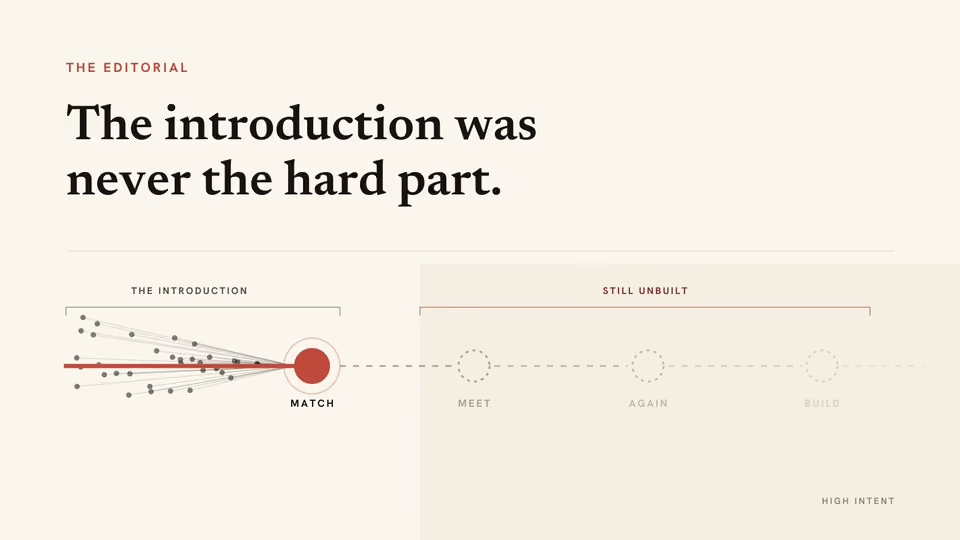
The current wave is heavily focused on the front end of the experience: better profiling, smarter recommendations, more thoughtful introductions. That part is genuinely improved. The hard part of dating has never been the introduction. The hard part is what happens after two people are put in front of each other: trust, conversion to an actual meeting, follow-through, and whether the connection compounds or dies.
Most of the AI products I have seen are still thin on that second half. They treat the match as the success event. Once the introduction is made, the product largely steps back and hopes for the best. That is the same failure mode as the swipe, just with a more expensive and sophisticated matching layer.
They treat the match as the success event.
If you are building one of these, the question I would force is simple: what does the product do after the AI makes the introduction? Does it improve the probability that the two people actually meet? Does it help them have a better first conversation? Does it increase the odds they meet again? Does it have any mechanism for learning from outcomes rather than just from stated preferences?
If the answer is mostly "the AI made a good match, now it is up to them," you have built a better recommendation engine on top of the same broken system.
The products that will matter are the ones that treat the entire arc, from first signal to repeated real-world interaction, as the design problem. AI can be extremely useful inside that arc. It is not a substitute for designing the arc itself.
I have watched this movie before. New technology arrives, the industry declares the old format dead, and a wave of products optimize the newly visible part of the problem while leaving the harder, less glamorous part untouched. The ones that survive are the ones that eventually confront the full problem.
How I'd approach it
If I were building in this space right now, I would reverse the usual order.
Most teams start with "how do we make a better match?" I would start with "what has to be true for two people to actually build something after we introduce them?" and work backward.
That forces different product decisions:
- You care more about verified intent and real-world follow-through than about conversation quality scores.
- You design for the meeting and the second meeting, not just the first message.
- You measure success by outcomes that happen offline, not by engagement metrics inside the app.
- You are willing to make the early experience slower and more demanding if it improves the quality of the people who make it through.
AI becomes a tool inside that system rather than the system itself.
The current wave is mostly doing the opposite: building impressive matching layers and then bolting on light tooling for what happens next. That approach will produce some nice demos and some early traction. It will not produce durable products.
The swipe taught us that a better way of browsing people is not the same thing as a better way of forming relationships. AI matchmaking is about to teach the same lesson with different technology.
Key takeaways
- 01Most AI matchmaking products are solving for better introductions, not better outcomes.
- 02The swipe failed because of misaligned incentives, not because the matching was insufficiently intelligent.
- 03Improving the recommendation layer while leaving the post-match experience thin repeats the same structural mistake.
- 04The products that matter will design the full arc from first signal to repeated real-world interaction.
- 05AI is a powerful tool inside that arc. It is not a replacement for designing the arc.
Reviewed by an operator. Last updated September 8, 2026. High Intent is led by founder and CEO Bill Alena, backed by a team of industry experts with over 100 years of online dating experience between them.
Questions operators ask
No. The technology is useful. The current product approach is what is limited.

Bill Alena
Bill Alena is the founder and CEO of High Intent Media. He has spent twenty-five years building and investing in dating companies, on both sides of the table.
He built myYearbook's revenue from $0 to $100M+ as Chief Revenue Officer. He ran all monetization at The Meet Group (NASDAQ: MEET) and helped grow it through four acquisitions. As Chief Investment & Growth Officer at Social Discovery Group, he grew revenue from $200M to $350M and led the company's M&A practice and a dating-only venture fund.
He founded High Intent to give operators in the dating industry the honest news, the platform, the services, and the capital they have never had access to from one place. He writes The Editorial weekly, on the business of dating, from an operator's chair.
Daily industry headlines, curated for operators.
M&A, funding, product, policy, and earnings. Free to read, never sponsored.