
Tinder Just Admitted Swiping Is Broken
Tinder is paying to get its own users off the app, and on its Q2 call Bumble teased a swipe-free future. That is not a product update. It is a confession, and it tells every founder where the next opening is.
From the Editor.
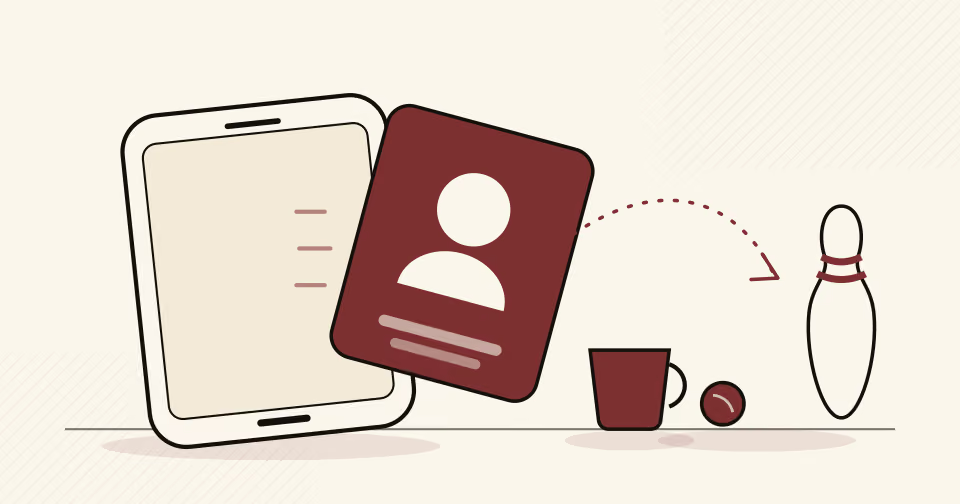
ay attention to what Tinder announced a few months ago. Not the AI features. Every app has those now. Not the virtual speed dating. The other thing: in-person events. Real ones, in the physical world. Bowling. Ceramics. Beach tennis. Tinder, the company that gave the English language a new verb, is now paying to get its users off the app.
Think about what that means for a minute.
Tinder didn't invent online dating. But it invented the format that came to define it. The fast, photo-first, binary swipe. Virtually every app that came after it copied some version of that mechanic. The swipe became so dominant that when people talk about quitting dating apps, what they usually mean is quitting swiping. The UX and the category became synonymous.
And now Tinder, the company with the most to lose from admitting that the format has a problem, is subsidizing bowling nights to get people off the app and into the same room.
That is not a feature launch. That is a confession.
It's exactly what I've been talking about over the past month. The swipe format is broken, and has been for a while.
Dating app usage dropped below 2018 levels in early 2026. Match Group's active users are down 37% year over year across the portfolio. Eighty percent of younger users in surveys say they're burned out by swiping. Singles events on Eventbrite doubled from 2022 to 2025, and matchmaking is skyrocketing. People are running clubs, private dinners, and wrestling-themed speed dating. They are walking away from the apps to go do real things in the real world.
None of this happened suddenly. The warning signs were legible for two years. But the big apps kept optimizing the swipe because the swipe was what they had. It drove engagement metrics, which drove ad revenue and conversion to paid tiers. Admitting the format was broken would have meant admitting the business model needed to change. So they didn't admit it. They added AI. They added prompts. They added video. They kept swiping.
Now Tinder is hosting ceramics classes.
And it's not just Tinder. This week, on its Q2 earnings call, Bumble teased a swipe-free future of its own. CEO Whitney Wolfe Herd pointed to early traction for Plans, its new app built around small-group, in-person hangouts rather than one-to-one matching, and signaled a coming redesign of the flagship app to replace high-volume swiping with "fewer, better, more considered signals." The company that built its brand on the first move is now telling investors the swipe itself is on its way out.
This is what it looks like when a category's dominant product finally catches up to what users figured out two years ago. The apps burned through goodwill, fake profiles, AI-generated bios, paywalls that hid better matches, and surveillance pricing that charged older users more. Users responded by leaving. The apps then tried to win them back with features. Users kept leaving. Now they're trying real life.
Here's what founders need to understand. The big players are not going IRL because they think it's the future. They're going IRL because they've run out of things to try within the format they built. Tinder is doing events the way a brand does a pop-up shop, as a customer acquisition and retention tactic, not a new business model. The app is still the app. They're just using physical events to remind people the app exists.
That is a very different thing from building for IRL from the start.
The move
The insight here isn't "build an events company." Thursday already pivoted to IRL events and reached a $50 million valuation. A creative events business can be a path. My overall point is more structural.
Tinder's IRL experiment tells you the next format shift in dating has already started, and it's moving toward lower-friction, higher-signal encounters, situations where the user can assess a real person in a real context before committing attention or money. The swipe abstracted away too much. The market is correcting.
That correction opens three specific windows.
Intentionality. The founders winning right now are the ones who built explicitly for people who want to end up in a relationship, not people who want to keep swiping. Hinge's 17% Q2 growth is the clearest data point. "Designed to be deleted" was a positioning line before it was a product truth. Make it a product truth first. Dating is going intentional.
Context. The reason IRL events work when the swipe doesn't isn't just that they're offline. It's that they give users a shared context to assess each other. You can read someone at a ceramics class in a way you can't read a photo and a prompt. Build digital experiences that carry the same signal load (voice, video, shared activity, real-time interaction) and you're solving the actual problem.
Trust. The incumbents burned it. Bumble is exploring a sale at a fraction of its peak value. Match is cutting staff. The user who left Tinder did not leave dating. They left a specific kind of dating experience that felt manipulative and exhausting.
The founders who build the thing that doesn't feel that way don't need to beat Tinder on features. They need to be the thing Tinder users go to when they're ready to try something new.
Tinder just told you what's not working. It spent $1.6 billion in revenue last year to figure that out. You get the lesson for free. Build something worth coming back to.
Key takeaways
- 01Tinder's move to in-person events is not a feature. It is an admission that the swipe format has stopped working.
- 02When the company that invented the swipe and the one that reinvented it both back away in the same quarter, that is the category confessing, not two isolated pivots.
- 03Incumbents are going IRL because they have run out of moves inside the format they built, not because they believe in it. That leaves the real product vision unclaimed.
- 04The openings are specific: intentionality, real context (voice, video, shared activity), and trust the incumbents have burned.
- 05You do not need to beat Tinder on features. You need to be where its users go when they are ready for something new.
Reviewed by an operator. Last updated August 8, 2026. High Intent is led by founder and CEO Bill Alena, backed by a team of industry experts with over 100 years of online dating experience between them.
Questions operators ask
No. Usage of the big swipe apps is falling and Match's active users are down about 37% year over year, but the category still generates billions and demand for connection is intact. What is breaking is the swipe format, not the market. The opening is for products that deliver that same demand in a better way.

Bill Alena
Bill Alena is the founder and CEO of High Intent Media. He has spent twenty-five years building and investing in dating companies, on both sides of the table.
He built myYearbook's revenue from $0 to $100M+ as Chief Revenue Officer. He ran all monetization at The Meet Group (NASDAQ: MEET) and helped grow it through four acquisitions. As Chief Investment & Growth Officer at Social Discovery Group, he grew revenue from $200M to $350M and led the company's M&A practice and a dating-only venture fund.
He founded High Intent to give operators in the dating industry the honest news, the platform, the services, and the capital they have never had access to from one place. He writes The Editorial weekly, on the business of dating, from an operator's chair.
Daily industry headlines, curated for operators.
M&A, funding, product, policy, and earnings. Free to read, never sponsored.